
Attention & Emotions - measured online
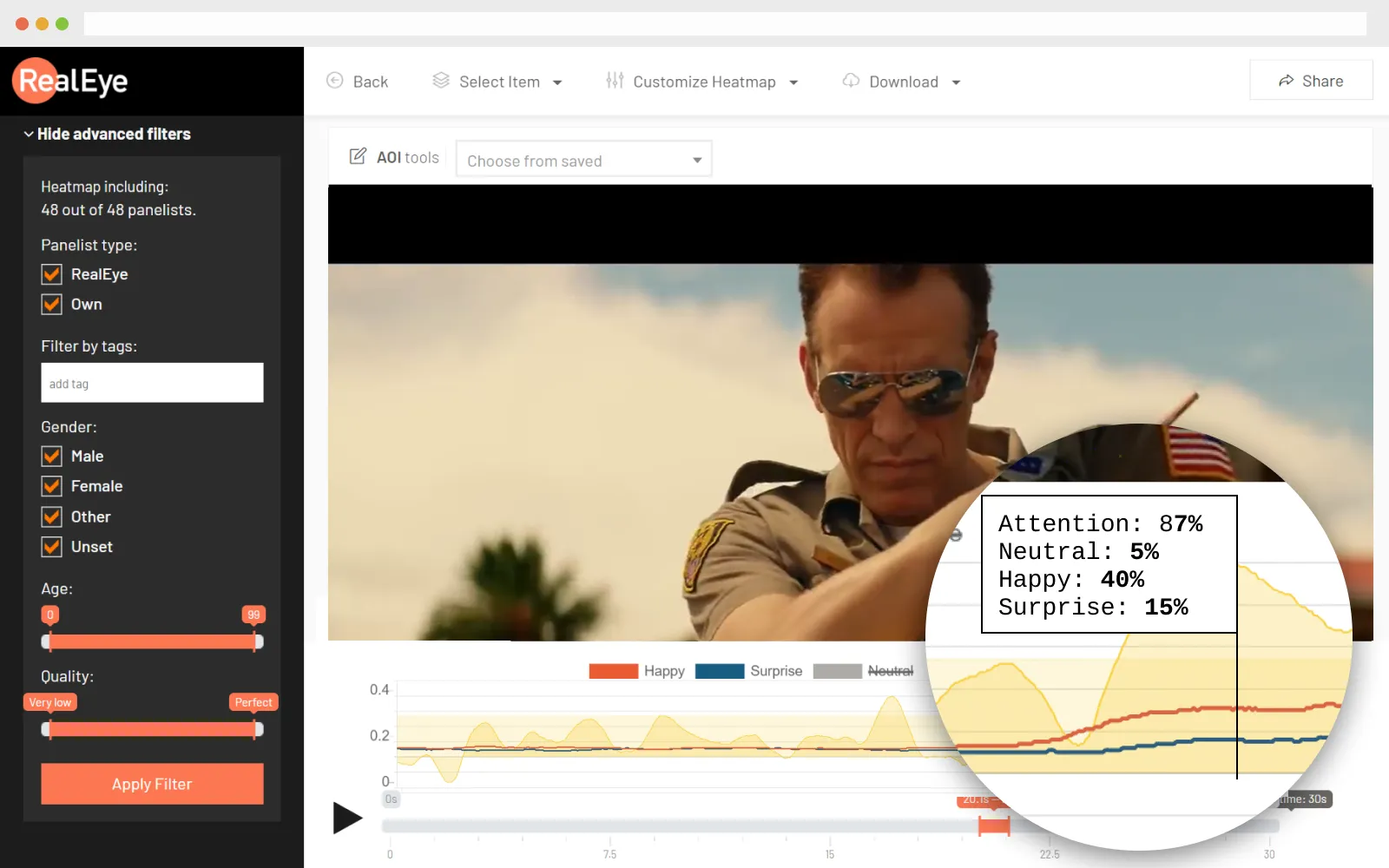
Attention is a cognitive process that tells us about somebody’s concentration and ability to actively process specific information. It's based on a methodology developed by a group of scientists from SWPS and Clemson University that succeeded in creating a K-coefficient. This parameter uses eye movement parameters (fixation duration and saccade amplitude) to define the path of attention dynamic of an examined person. Facial Coding allows you to track the emotions on the participants' faces. It's based on a methodology developed by Carl-Herman Hjortsjö and adopted in 1972 by Paul Ekman and Wallace V. Friesen for interpreting emotional states by facial muscle movements (FACS). Now, computer vision supported with AI algorithms allows us to analyze people's emotions online.






Attention measurement with eye-tracking & K-coefficient - explained
There were many attempts to create a dynamic visual attention indicator. Finally a group of scientists from SWPS and Clemson University (who we had the pleasure to meet and work with) succeeded in creating a K-coefficient. This parameter uses eye movement parameters (fixation duration and saccade amplitude) to define the path of attention dynamic of an examined person.

Interviewing Krzysztof Krejtz
In eye-tracking research, we can distinguish two general types of visual attention: ambient and focal. Ambient attention indicates a scanning pattern over stimuli (typical for the early stages of scene perception), characterized by short duration fixations followed by long saccades. On the other hand, longer fixations followed by shorter saccades indicate focal attention. The more focal processing of the stimuli, the deeper attention is given, which can mean that someone is actively processing the information.
Read more...Eager to know more?

Attention Measurements with K-Coefficient
In eye-tracking research, we can distinguish two general types of visual attention: ambient and focal. Ambient attention indicates a scanning pattern over stimuli (typical for the early stages of scene perception), characterized by short duration fixations followed by long saccades. (...)
Learn More...Facial Action Coding System
The Facial Action Coding System (FACS) is a system that allows the quantification and measurement of facial movements. It was initially developed by a Swedish anatomist - Carl-Herman Hjortsjö, and adopted by Paul Ekman and Wallace V. Friesen in 1978. Ekman and Friesen later updated the system in 2002. (...)
Learn More...Technical specification
-
Works with any webcamWe recommend at least 640x480p resolution.
-
Works with Chrome/Firefox/Edge/SafariWe recommend using Chromium-based browsers (Chrome, Edge).
-
30Hz sampling rateWe're collecting the data every 33ms
-
Individual calibrationCalculations are performed after individual calibration.
-
Up to 60 minutes long sessionsThe maximum study length depends on the license.
-
GDPR compliant
 We don't store any panelist videos or images. Read more here


"Webcam-based eye-tracking has vast potential within market research and RealEye made a great effort customizing their solutions to our needs. We succeeded in having live online interviews with eye-tracking included and we look forward to build on this pilot study to take further advantage of this solution in future research."


"I'm really impressed with what Adam has created with RealEye. It's astounding how easy and fast it is to track and report on eye movement for a page or design."

Frequently Asked Questions
Who can participate in my study?
Note: RealEye participants can't take part in a 'Live Website' studies and studies longer than 10 minutes. Read more about the limitations here.
What’s the difference between own and RealEye panelists?
Note: RealEye participants can't take part in a 'Live Website' studies and studies longer than 10 minutes. Read more about the limitations here
Can I get more participants?
When you order RealEye panelists, we make sure to provide the highest quality results. All recordings are checked by us to make sure that you get results with an accuracy of fewer than 175 pixels and at least a 20 Hz sampling rate. Assuring high-quality results usually requires us to pay for and check more panelists than you've requested, but we take that cost on us - so you pay only for the best results.
What equipment or setup does RealEye require?
Do you provide Eye-Tracking Reports?
Can I integrate RealEye with other tools?
I have another question
Understanding Facial Coding: A Guide to Facial Expression Technology
Have you heard about algorithms that can automatically recognize emotions just by measuring facial expressions? This tool, called face coding, is becoming popular because of its ability to expand our understanding of emotions, based on people’s facial expressions. By tracking facial expressions in real-time, researchers can capture moments of engagement, joy, or even frustration. Fascinating!
What is Facial Coding?
Facial coding is a process that quantifies emotional responses to digital content. It's deeply rooted in Paul Ekman's research, uses software and webcam capture to interpret complex human emotions through facial expressions. Dr. Ekman's research has identified six basic emotional expressions that are universally recognized across cultures.
These expressions are:
- Anger,
- Happiness,
- Surprise,
- Disgust,
- Sadness
- Fear,
And they are distinguished by different facial muscle movements. This highlights the universality of emotions through facial expressions, making facial coding technology an important tool in market research all over the world.
In 1978, Ekman and Friesen released the Facial Action Coding System (FACS), which maps the movements of facial muscles. Facial Action Coding System decays the facial behavior into 46 so-called action units. What are precisely action units? As we wrote in previous article „They are defined as contractions or relaxations of one or more facial muscles. The FACS manual has over 500 pages and describes all action units along with their meaning according to Ekman’s interpretation”.
The Facial Action Coding System has changed how emotional responses are interpreted. This approach has improved the accuracy of facial coding, making it a great technique for ad and video testing among research and advertisement agencies. By tapping into consumers' emotional responses, researchers can gain deeper insights into how people react to stimuli. This, in turn, enables companies and agencies to create more effective marketing campaigns and products that resonate with their target audience.
How Facial Coding Technology Works
The science behind facial coding is relatively simple. It records facial expressions via webcam and analyzes them using facial coding software.
The process of face coding typically involves these steps:
- Stimulus presentation: Participants are exposed to stimuli, such as an advertisement, product, or experience.
- Facial expression and emotions recording: The participant's facial expressions are recorded using a camera or webcam that track tiny movements of facial muscles. With RealEye, this can be done remotely using the participant's own device, so you don't need any extra equipment.
- Facial coding analysis: Now, the software analyzes the recorded facial expressions frame by frame to identify specific emotions and movements of facial muscles. This process is known as coding. The algorithm seeks to determine the emotional responses' type, intensity, and duration.
- Interpretation and reporting: The results of the face coding analysis are interpreted to deliver insights into the participant's emotional reactions.
Face coding is often used with other research methods, such as surveys or eye-tracking. It provides insights into user experience, marketing, and product development strategies.
In What Types of Research Facial Coding is Used?
Facial coding has revolutionized the way we understand basic emotions. This amazing research tool can be used in many industries.
Automated facial coding is very popular in marketing and consumer research. Marketers love face coding! They use trackers like RealEye to measure emotional responses to their campaigns. This research technique provides moment-by-moment emotional and cognitive metrics, allowing for optimized marketing strategies and more effective ad campaigns.
Facial coding can also help with your market research. One effective way to gather insights into customers' feelings about your products is to conduct market research using face coding. This can help you find areas for improvement and make adjustments before your products hit the store shelves. You can also proactively handle any negative feedback that may come your way.
Is Face Coding the Same Thing as Face Recognition?
That’s a great question! If you need a TLDR type of answer, it’s a short: no. The terms „face coding” and „face recognition” are related concepts but serve different purposes.
The coding process typically doesn't involve identifying specific individuals but focuses on interpreting basic emotions and reactions based on facial expressions. It also utilizes the previously mentioned Facial Action Coding System (FACS) to categorize and analyze facial movements.
Face recognition, on the other hand, was created to verify individuals' identities based on their facial features. It's a process that involves comparing a person's face with a database of known faces to see if there's a match. It has applications, e.g., in security systems, access control, law enforcement, and digital authentication.
What Are The Pros of Facial Coding?
You already know a lot about face coding and its use on the market. What are the top strengths of this tool?
- Facial coding integrates data from eye-tracking, emotion recognition, and declarative surveys in just one tool.
- It’s easy to use. Participants take the test in the comfort of their own homes, so they get to experience a natural, non-corrupted laboratory environment. This allows them to fully concentrate and perform to the best results.
- In order to compare how different target groups perceive an ad, you can easily filter the answers. For example, you can filter by gender or age, or you can create your own tags to filter results by survey answers.
- Sometimes, participants may not realize that they liked a piece of content or may not have wanted to admit that they liked it. This type of study helps us understand the actual behavior of participants rather than just their verbal responses.
- Before launching your ad campaign, you can allocate a higher budget to ads with the highest score and save some money.
- You receive the results immediately after the study.
The Future of Facial Coding
It's exciting to see how facial coding changes how technology interacts with human emotions.
Emotion AI Integration: In 2018, Gartner's Top Predictions Report predicted that by 2022, 10% of devices would possess emotion AI capabilities. In 2019, Gartner further predicted that by 2024, AI's ability to identify emotions would seriously impact over half of the online advertisements users experience.
Transformational Impact: When used ethically, facial coding possesses the remarkable ability to improve consumer interactions, redefine entire industries, and positively impact people's lives.
Ethical Issue: As more companies use facial coding, it's important to manage issues around privacy and consent. Responsible implementation and transparency are essential for the benefit of everyone involved.
The world is in a constant change, and technology never stops to amaze us. To keep up with the competition, it is wise to use the latest tools and metrics that the market offers. Facial coding can help businesses recognize emotions, but many are unaware of its importance.
Experience the power of Face coding and take your content to the next level!

