

COVID-19 Changed the Way We Look at Each Other. Eye Tracking Proved It.
 RealEye
During the height of the pandemic, a group of researchers asked a question most people were feeling but nobody had measured: did fear of COVID change the way we look at other people’s faces?
Not the way we think about them. Not the way we talk about them. The way our eyes physically move across them in the first 200 milliseconds. The part that happens before thought, before judgment, before any conscious decision is made. The part we have no control over and no awareness of.
The answer was yes. And the data was striking enough to make it into peer-reviewed scientific literature as the first evidence of its kind.
The Study
In November 2020, at the peak of pandemic restrictions across Europe, researchers Tiziana Federico, Dario Ferrante, Fulvio Marcatto and Maria A. Brandimonte conducted an eye-tracking study that became the first evidence in scientific literature of COVID-19 affecting human social interaction at the most fundamental perceptual level.
They showed 50 participants a series of photographs of human faces. Each face was labeled with one of three captions: COVID-free, sick with COVID, or recovered from COVID. The faces themselves were identical across conditions. Only the label changed. Participants were asked to simply look at the faces naturally, as they would in any encounter. Their eye movements were recorded and analyzed across multiple areas of interest: the eyes, the nose, the mouth, and the broader facial region.
The study was conducted entirely online, using RealEye as the remote eye-tracking platform. No lab. No physical presence required. Participants joined from their own homes, on their own devices, using only their built-in webcams. At a time when laboratory research had essentially stopped across the world, this research continued without interruption. The pandemic that was the subject of the study was also the condition that made traditional research impossible. Remote eye-tracking solved that contradiction.
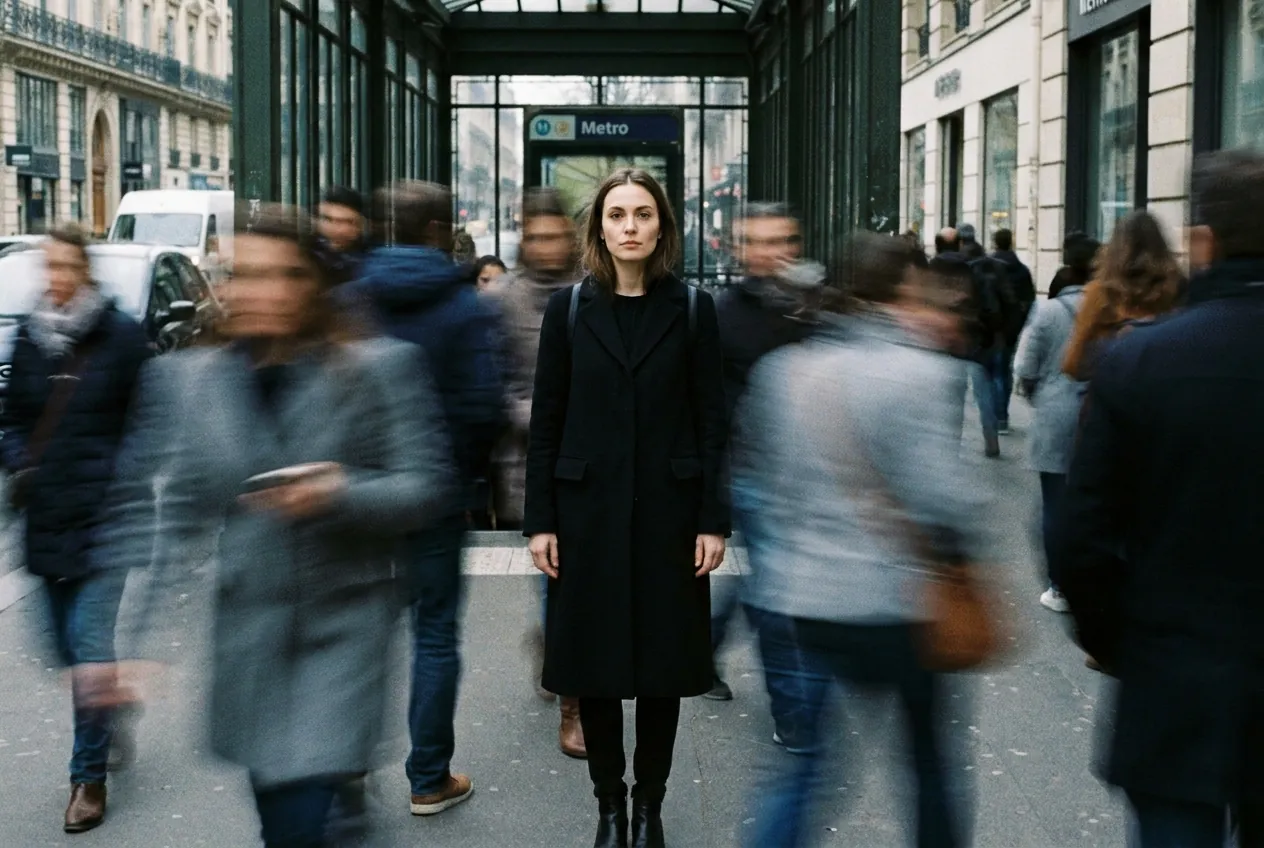
What the Eyes Showed
When participants looked at a face labeled as COVID-free, they behaved the way humans always behave when looking at another person’s face: they looked at the eyes. Eye contact, even with a photograph, is the default mode of human social perception. We look to the eyes first and longest. We read emotion, intention, trustworthiness, and connection from the eyes. It is deeply wired, cross-cultural, and present from the earliest weeks of life.
When the same face appeared under the label “sick with COVID,” something measurable shifted. Participants spent approximately 200 milliseconds less time looking at the eye region, and approximately 200 milliseconds more time looking at the mouth and the lower half of the face. That shift sounds small in absolute terms. A fifth of a second. But across 50 participants and multiple trials it was consistent, statistically significant, and most importantly, it appeared within the first 500 milliseconds of viewing. Before any deliberate thought could have shaped the behavior. The gaze had already moved before the mind caught up.
The brain was reading the label and rerouting attention automatically. Risk perception correlated with gaze patterns with a correlation coefficient of 0.41. The more afraid of COVID a participant reported being, the more dramatically their eyes shifted away from the eyes of labeled faces and toward the mouth. Fear was not just a feeling. It was a measurable pattern written into where the eyes went.
The Finding That Stands Out
Among all the results in this study, one is particularly worth stopping on.
Recovered faces. Faces explicitly labeled as recovered from COVID, no longer sick, no longer presenting any risk. Participants were shown this label clearly. They had every reason, consciously, to treat a recovered person the same as a COVID-free one.
Their eyes disagreed.
The gaze pattern for recovered faces was statistically indistinguishable from the gaze pattern for sick faces. Less eye contact than COVID-free faces. More attention to the mouth. The same avoidance, the same downward shift of attention, applied with the same consistency to someone the participant had been told was completely fine. The researchers noted this finding was consistent with broader scientific literature on disease stigma, where the social consequences of illness often outlast the illness itself. But this was the first time it had been observed at the level of live eye movement data during an active pandemic, in real time, with real participants.
People’s eyes were carrying a bias that their conscious minds had already resolved. The stigma had not lifted. It had simply gone underground, into the automatic layer of perception where we have no access to it and therefore cannot question it, correct it, or even know it is there. Nobody knew. Because nobody had thought to ask the eyes.
Why This Matters Beyond the Pandemic
COVID is the context of this study, but what it demonstrates is something far more universal and far more consequential.
Human gaze is not a neutral instrument. It is continuously shaped by the information we carry, the fears we hold, the associations we have formed, and the social context we are operating in. A single word placed above a photograph changed where 50 people’s eyes went within a fraction of a second, and it did so consistently across trials, consistently across participants, and in ways that correlated with their deeper psychological state. That is not a quirk of pandemic psychology. That is how human attention works, in every context, every day.
In healthcare, the way a clinician looks at a patient affects how heard and respected that patient feels during the interaction. In hiring, the direction of a recruiter’s gaze during a conversation shapes the impression they form before a word is evaluated. In advertising, whatever context a viewer brings to the moment of exposure changes where their eyes go on the creative and what gets encoded into memory. In retail, a product’s shelf position, label, and surrounding context alter the gaze behavior of every shopper who passes it, regardless of their stated preferences. In any environment where human perception determines outcomes, the automatic layer of gaze behavior is where the real story lives, and surveys will never reach it.
The Platform That Made It Possible
November 2020. Lockdowns across Europe and beyond. University laboratories closed. International travel impossible. The kind of study that would normally require participants to travel to a controlled environment, undergo equipment calibration, and spend an hour in a room with a researcher could not happen.
This study happened anyway. Fifty participants, recruited remotely, sitting in their own homes, tracked through their own built-in webcams, using RealEye. The data was clean enough to publish. The findings were significant enough to enter the scientific record. And the entire study ran during a period when the alternative, a traditional lab setup, was simply not an option.
This is not a minor logistical footnote. It is a proof of concept for what remote eye-tracking makes possible in behavioral science. Research that previously required institutional resources, physical infrastructure, and months of scheduling can now reach real participants in real environments at a fraction of the cost and time. The Federico et al. study did not compromise on scientific rigor to achieve this. It produced peer-reviewed, published findings that are cited in the literature today.
What This Opens Up
The Federico et al. study is four years old now. COVID restrictions are behind us. But the questions it raised about automatic human perception, social stigma encoded in gaze, and the gap between what people consciously believe and what their eyes actually do are as relevant today as they were in November 2020.
How does political polarization change the way we look at faces associated with the other side? How does burnout affect the visual attention of healthcare professionals during patient interactions? How do children from different social environments develop gaze patterns that shape their social development? How does brand reputation, negative press, or a single association change the way consumers look at a product before they have consciously registered what they think about it?
These are not marginal research questions. They sit at the center of psychology, behavioral science, public health, consumer research, and organizational behavior. And they are questions that surveys cannot answer honestly, because the behavior they describe happens at a level the person being surveyed does not have access to.
Remote webcam eye-tracking does not replace every form of laboratory measurement. But for behavioral research that needs scale, real-world participants, and access to automatic perceptual responses rather than post-hoc self-report, it makes territory accessible that was previously out of reach for most researchers, most institutions, and most budgets.
If you work in any field where understanding how humans actually perceive the world matters, the infrastructure to study that question now exists. It runs through a browser link. It starts in seven days. And it does not require a lab.
Start at realeye.io.
Source: Federico, Ferrante, Marcatto & Brandimonte (2021). “COVID-19 Lockdown Has Changed the Way We Look at Faces.” PeerJ 9:e11380.


